
 Download
 Searchable
Shut-Off Valves for Abrasive Pneumatic Conveying
In abrasive pneumatic conveying lines, stopping material flow is only part of the challenge. Valves must also protect the internal flow path from repeated wear and remain practical to service during maintenance intervals.
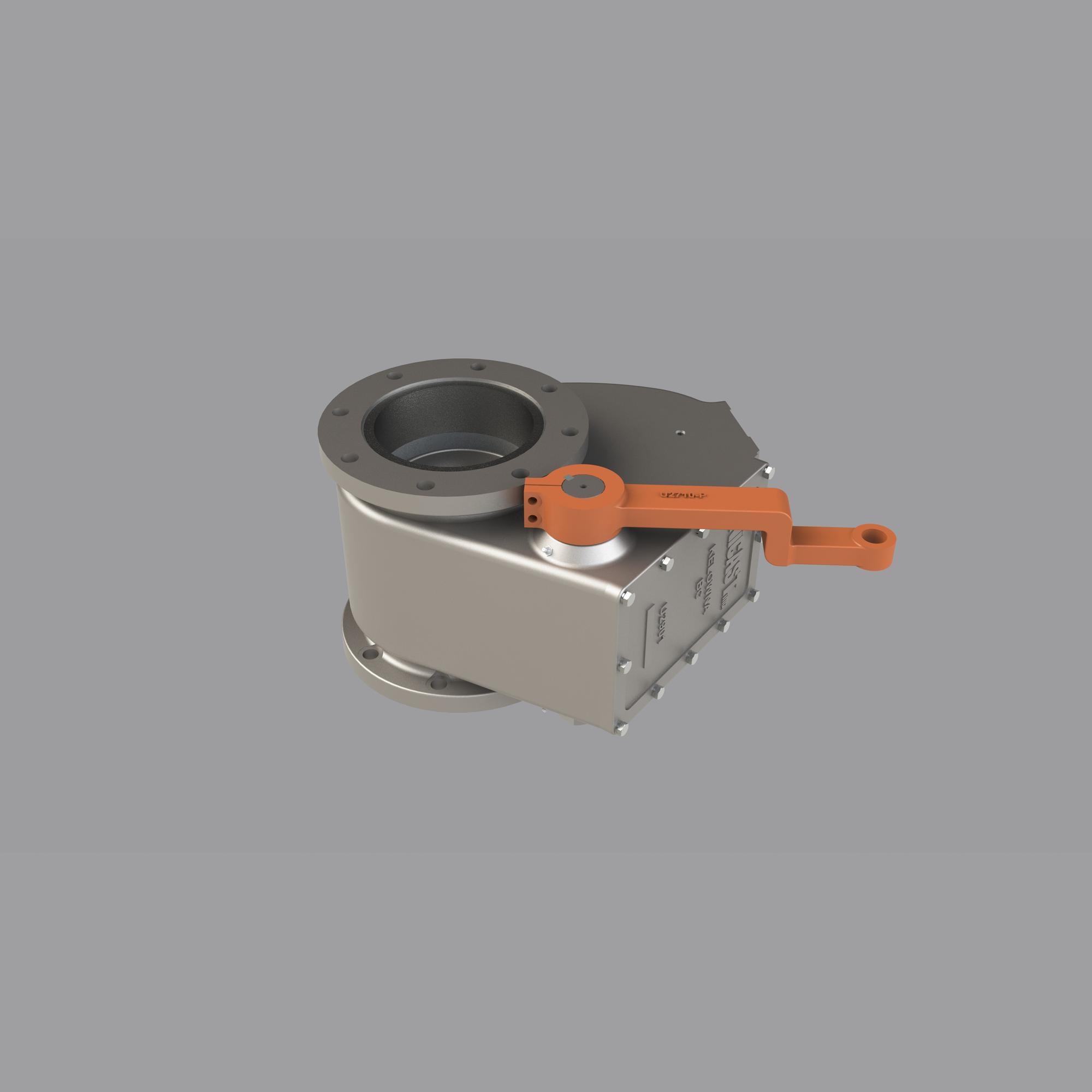
Unicast Shut-Off Valves provide positive shut-off of abrasive media using one-piece high-chrome iron seats and liners on both the inlet and outlet sides. A large access panel allows the gate and seat to be replaced inline, without removing the valve body from the conveying line.
Designed for unidirectional flow, the valve combines wear protection, compact installation dimensions, and direct access to the components in high-wear areas.


Why Conventional Shut-Off Valves Create Maintenance Problems
In pneumatic conveying systems, abrasive particles repeatedly pass across the gate, seat, and surrounding flow surfaces.
These components eventually become maintenance items. The larger operational problem appears when reaching them requires the complete valve to be disconnected and removed from the line.
What should be a controlled gate or seat replacement can then involve actuator disconnection, pipework handling, lifting equipment, realignment, and recommissioning. The maintenance scope becomes much larger than the wear-part replacement itself.
An effective shut-off valve for abrasive service therefore needs to address both sides of the problem: protect the areas exposed to material flow and provide practical access to the components expected to wear.
Engineering Solution
Inline Gate and Seat Access
A large access panel allows maintenance teams to reach and replace the gate and seat without removing the valve body from the conveying line.
This keeps routine service focused on the replaceable components instead of turning it into a full valve-removal project.

High-Chrome Protection Through the Flow Path
One-piece high-chrome iron seats and liners are installed on both the inlet and outlet sides.
This places abrasion-resistant material around the areas directly exposed to the conveyed media and helps protect the main valve assembly from abrasive contact.
Stepped Shaft for Gate Replacement
The stepped shaft provides rigid placement of the internal lever. Its tension adjustment is designed to allow the gate to be replaced in minutes.
The shaft is also sealed and lubricated to protect the operating mechanism during service.
Technical Construction
| Component or Feature | Design |
|---|---|
| Intended service | Positive shut-off of abrasive media in pneumatic conveying lines |
| Flow direction | Unidirectional only |
| Seats and liners | One-piece high-chrome iron components on the inlet and outlet sides |
| Maintenance access | Large access panel for inline gate and seat replacement |
| Gate mechanism | Stepped shaft with rigid internal-lever placement and tension adjustment |
| Shaft protection | Sealed and lubricated |
| Installation dimensions | Standard flange-to-flange dimensions |
| Configuration | Right-left convertibility |
| Actuation | Available in Pneumatic, Electric and Manual Options |
Performance and Lifecycle Impact
The lifecycle value of the Unicast Shut-Off Valve comes primarily from reducing the scope of maintenance.
When gate or seat service is required, the valve body can remain connected to the conveying line. This can reduce the handling, disconnection, alignment, and recommissioning work associated with removing a complete valve assembly.
The high-chrome seats and liners protect the main areas exposed to abrasive material, while the stepped shaft is designed to make gate replacement more direct.
Standard flange-to-flange dimensions can also simplify replacement planning where the existing installation uses comparable spacing.
Actual service life will depend on the conveyed material, particle characteristics, operating conditions, cycling frequency, and system configuration.
Application Fit
Unicast Shut-Off Valves are designed for dry abrasive bulk material systems that require positive shut-off within a pneumatic conveying line.
They feature:
- Cement processing and conveying
- Mineral processing
- Aggregate handling
- Coal handling
- Abrasive material feed and discharge points
- Isolation points upstream or downstream of routing equipment
- Retrofit installations where available flange spacing is limited
The strongest application fit is a system where the gate and seat are predictable maintenance components and removing the entire valve would add unnecessary work or downtime.
Application Limits
The supplied specifications establish that the valve:
- Is intended for unidirectional flow
- Is designed for dry abrasive media. Must be evaluated against the required line dimensions and operating conditions
Compatibility With Existing Infrastructure
The compact design uses standard flange-to-flange dimensions intended to fit the spacing used by other commonly installed valve designs.
This may reduce surrounding pipework changes during a replacement project, but it does not establish universal interchangeability.
Before replacement, confirm:
- Line diameter
- Flange type and drilling pattern
- Face-to-face dimensions
- Material flow direction
- Access-panel service clearance
- Actuator orientation
Unicast Shut-off Valve vs. Knife Gate Valves for Dry Abrasive Material Transport
| Factor | Unicast One-way Shutoff Valves | Knife Gate Valves |
|---|---|---|
| Housing | Cast ductile iron body – sturdy construction which will last the test of time | Fabricated from plate steel, limiting the use of wear-resistant components. |
| Wear Components | Seats, Gates and Sleeves - Cast in wear-resistant high chrome white iron for increased abrasion resistance | Seat and Gate – Fabricated in Stainless Steel, PTFE, etc. |
| Weight and Footprint | Heavier and occupies a larger area | Lighter and compact footprint |
| Maintenance | Easy in-line maintenance via access panel – Less Downtime, more Cost Savings! | Time-consuming as valve needs to be removed from line for maintenance and wear parts replacement |
| Contamination Risk | Low – In the event of leakage, the media stays within the body of the shutoff valve | High – In the absence of a body, the wear components are exposed to environmental elements and any leaks release media into the air. |
| Total Cost of Ownership | Low – Higher initial cost but long-term savings recognized in less downtime, and low frequency of wear parts replacement | High – Low initial cost but costs incurred over life of use are significant: out-of-line maintenance, downtime, higher frequency of valve replacements |
Frequently Asked Questions
- What role does a Shut-Off Valve serve in a pneumatic conveying system?
- Shut-off valves, as the name suggests, arrest the flow completely, creating a tight seal. Shut-off valves can play many roles in a powder delivery system. Section isolation for maintenance or to control which zones are receiving material can be achieved with shut-off valves without shutting down the entire delivery system. Shut-off valves can also prevent backflow and contamination, or can even be used as safety mechanisms for shutting systems down in an emergency.
The Unicast Shut-Off Valve is designed specifically for abrasive media in unidirectional pneumatic conveying lines. - How is the Unicast Shut-off valve maintained?
- The large access panel allows the internal components to be reached while the valve body remains installed. This can reduce the pipework handling, actuator disconnection, alignment work, and recommissioning associated with full valve removal.
- Can the Shut-Off Valve replace an existing valve without modifying the conveying line?
- The valve is designed with standard flange-to-flange dimensions intended to fit spacing used by other commonly installed valve designs.
This may reduce piping modifications, but exact flange-to-flange dimensions, line diameter, pressure requirements, and service clearance must be confirmed before replacement. - Which actuations are available?
- Pneumatic actuation with a single-solenoid controller and reed-type limit switches
- Electric gear motor actuation with limit switches
- Manual Actuation
- Can the Shut-Off Valve be used for reverse flow or bidirectional service?
- The valve is intended for unidirectional flow only. However, if bidirectional flow is required, contact us for other valve options.
Request a Quote or Technical Evaluation
If maintenance, excessive wear or leakage of media is a concern in your operation, Unicast can review the application and determine whether the Shut-Off Valve is a suitable fit.
For a technical evaluation, provide the conveyed material, line size, flange requirements, flow direction, operating pressure and temperature, preferred actuation method, and available maintenance clearance.