
 Download
 Searchable
Carbide Wear Parts and Components: Applications, Benefits, and How to Choose the Right Solution
May 13, 2026

Where carbide actually enters the conversation
In most operations, carbide isn’t part of the first design discussion.
It shows up later, usually after something has already gone wrong.
A set of blow bars fractures earlier than expected. Hammers wear unevenly and start affecting product consistency. Change-outs creep closer together until maintenance becomes reactive instead of planned.
That’s when carbide gets brought up, not as a preference, but as a question:
“Is there something that will actually last in this environment?”
Not all carbides behave the same in the field
“Carbide” tends to get used as a blanket term, but in practice, there’s a significant difference between how carbide is implemented.
In crushing and impact applications, the conversation is rarely about pure carbide components. It’s about how carbide is integrated into a tougher base material.
A common approach, and one that shows up repeatedly in real operations, is the use of titanium carbide inserts embedded within a manganese steel body.
This matters because it addresses one of the main limitations of carbide:
- Carbide resists wear extremely well
- Manganese steel absorbs impact and work-hardens over time
That combination changes how the part behaves under load.
Instead of choosing between hardness and toughness, you’re distributing both across the component.
Where carbide-based solutions actually perform
In mining and cement environments, carbide wear parts applications tend to cluster around high-abrasion, high-throughput zones, especially where wear is predictable and continuous.
You’ll typically see them in:
- Impactor blow bars and crusher hammers
- Breaker blocks and jaw plates
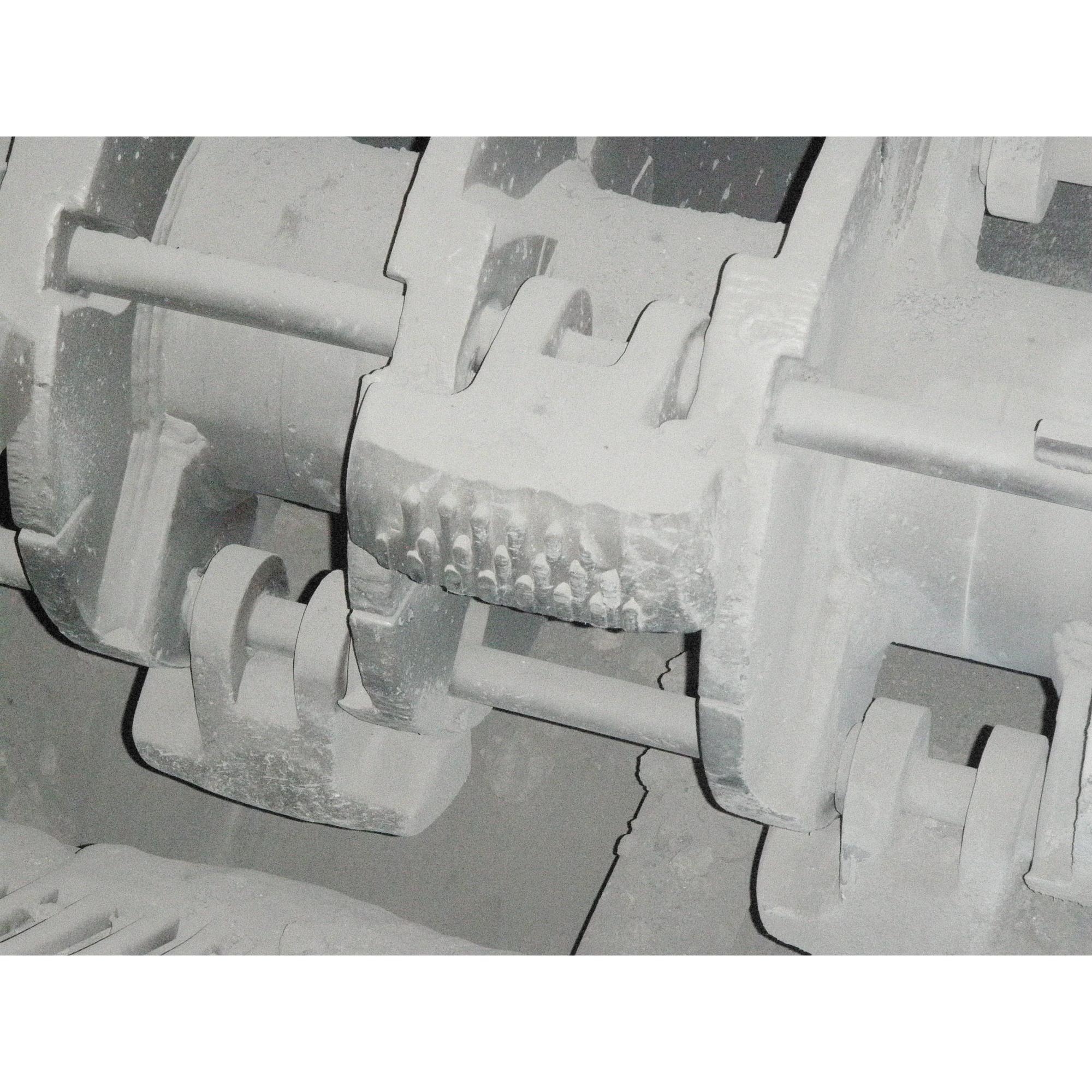
- Clinker cooler hammer systems
- Limestone and recycled material crushing
In these applications, wear isn’t random. It’s concentrated in specific zones.
That’s where targeted reinforcement, like carbide inserts, becomes effective.
Unicast Clinker Breaker Hammers Installed
What changes when carbide is introduced
In controlled conditions, carbide doesn’t just extend life, it stabilizes performance.
Operators often notice:
- A more consistent wear profile over time
- Less variation in output material size
- Fewer unexpected failures due to localized wear
That consistency matters as much as durability, especially in systems where product uniformity affects downstream efficiency.
Real-world performance isn’t theoretical
Field data tends to tell a more useful story than material specs.
In impact crushing applications, there are cases where:
- Ceramic-embedded blow bars fractured after relatively low throughput
- Switching to titanium carbide-reinforced designs extended the usable life significantly
Similarly, in cement applications:
- Standard hammers operating in limestone environments required frequent replacement
- Titanium carbide-reinforced versions increased service life while maintaining structural integrity
The pattern isn’t surprising.
Ceramics offer extreme hardness but struggle under impact.
High chrome materials resist abrasion but can become brittle.
Carbide, when integrated properly, sits in between, offering wear resistance without sacrificing structural resilience.
Why hardness alone doesn’t solve the problem
A common assumption is that increasing hardness will always improve wear life.
In practice, that only holds true in purely abrasive environments.
Most crushing systems introduce a mix of:
- Abrasion
- Impact
- Variable feed conditions
According to ASM International, material performance in wear applications depends on balancing hardness with fracture resistance.
That’s why solutions that combine materials, rather than rely on a single property, tend to perform more reliably.
The role of base material still matters
One detail that often gets overlooked is the base material behind the carbide.
In many heavy-duty applications, manganese steel is used because it work-hardens under impact.
That means:
- The material becomes harder as it operates
- It adapts to the stress conditions over time
When combined with carbide inserts in high-wear zones, this creates a system where:
- Impact is absorbed
- Abrasion is resisted
That interaction is what drives real-world performance, not the carbide alone.
Where carbide solutions fail (and why)
Even well-designed carbide wear parts can fail if the application isn’t understood properly.
Typical issues show up when:
- Impact loads exceed what the insert configuration can handle
- Feed material is inconsistent, creating unpredictable stress
- Installation or balance issues introduce uneven loading
In clinker cooler environments, for example, temperature and impact variability can quickly expose weaknesses in materials that are too brittle or not properly supported.
That’s why some hard materials perform well in lab conditions but fail in production.
How engineers actually evaluate carbide wear parts
The decision isn’t “should we use carbide?”
It’s:
“Does this system benefit from localized reinforcement or full material replacement?”
That usually comes down to:
Wear localization
Is wear concentrated in specific zones, or uniform across the part?
Impact conditions
Is the system dominated by abrasion, or is impact unavoidable?
Maintenance strategy
Is the goal longer intervals or more predictable wear?
System stability
Are feed conditions controlled, or highly variable?
A practical observation, most teams recognize
In systems like clinker breakers or impact crushers, teams don’t usually need the entire component to be ultra-hard.
They need specific areas to resist wear, while the rest of the structure survives the load.
That’s where targeted carbide reinforcement makes sense.
Not as a blanket upgrade, but as a focused solution to a known wear pattern.
Final thought
Carbide wear parts are effective, but only when the problem is clearly defined.
In most operations, the difference between success and failure isn’t the presence of carbide. It’s whether the design reflects how the material actually moves, impacts, and wears inside the system.
For teams dealing with recurring wear in crushing or clinker handling systems, the next step is rarely changing materials blindly. It’s understanding where wear is concentrated and how reinforcement is applied.
That’s where more targeted carbide solutions, particularly those using localized inserts rather than full material replacement, tend to deliver more consistent results.
Next step
If you’re evaluating carbide wear parts applications in your operation, reviewing how insert-based designs perform in real components can help clarify what’s worth testing next.
Explore Unicast’s carbide wear parts and titanium carbide solutions to see how these approaches are applied in high-abrasion crushing and clinker handling environments.